


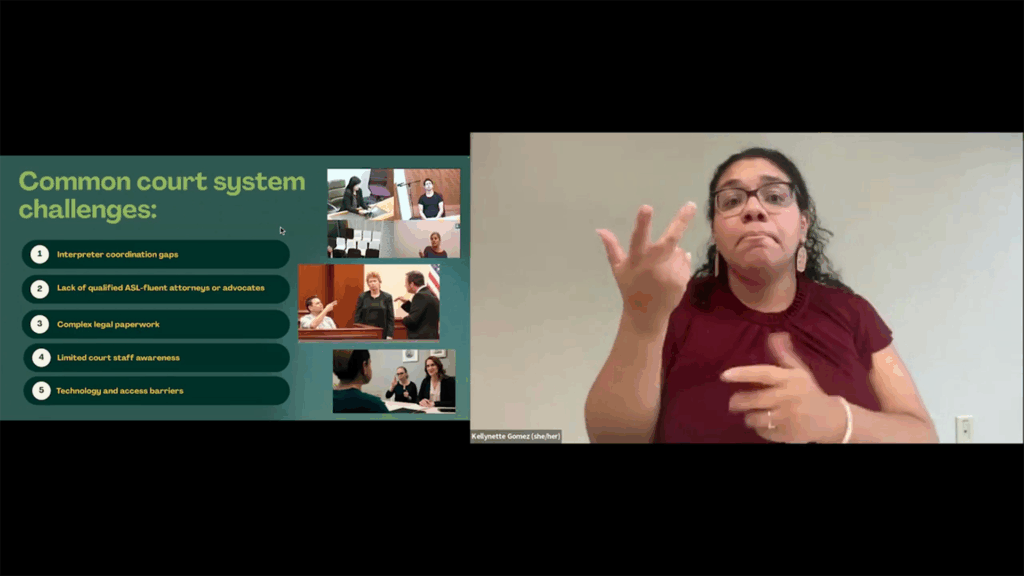
Navigating Client Needs in Legal Contexts: A Social Worker’s Perspective for Interpreters
Presented By: Kellynette Gomez, LCSW
Course Duration: 2 hours
Subscription: 6 Months
CEU Credits: .2 Legal
Navigating Client Needs in Legal Contexts: A Social Worker’s Perspective for Interpreters
Price range: $37.49 through $49.99
Course Description & Objectives
Social workers often support clients who are navigating complex legal systems, from family court to immigration proceedings. This workshop will provide interpreters with insights into the role of social workers in these settings, with particular attention to working with Deaf and hard-of-hearing clients who rely on American Sign Language (ASL). This session will highlight the challenges clients face, the support social workers provide, and how interpreters can use this understanding to facilitate accurate, empathetic, and culturally responsive communication. Emphasis will be placed on the importance of considering client well-being alongside legal procedures, as well as how interpreters can recognize and utilize the unique familiarity social workers may have with a client’s history and needs to inform effective decision-making in interpreted interactions.
Upon completion of this session, participants will be able to:
- List a minimum of three responsibilities social workers have in legal settings such as family court, immigration, and child welfare proceedings.
- Identify a minimum of three unique challenges faced by Deaf and hard-of-hearing clients navigating legal systems.
- Discuss a minimum of three strategies for ensuring accurate, culturally competent interpretation in ASL within legal-social work contexts.
- Describe a minimum of two ways social workers’ insights and familiarity with client circumstances can support interpreters in facilitating effective communication.
- Identify a minimum of two approaches to apply a trauma-informed and client-centered lens to interpreting practice in legal-social work settings.



Additional information
| Access Type | DO NOT RECEIVE CEUs, RECEIVE CEUs |
|---|
Related products
-
Enroll in the course This product has multiple variants. The options may be chosen on the product page

Medical Interpreting Fish Bowl: Discussing Teaming and Trust
Price range: $37.49 through $49.99 -
Enroll in the course This product has multiple variants. The options may be chosen on the product page
Marketing 101 for Interpreters – Key Terms & Concepts
Price range: $37.49 through $49.99 -
Enroll in the course This product has multiple variants. The options may be chosen on the product page
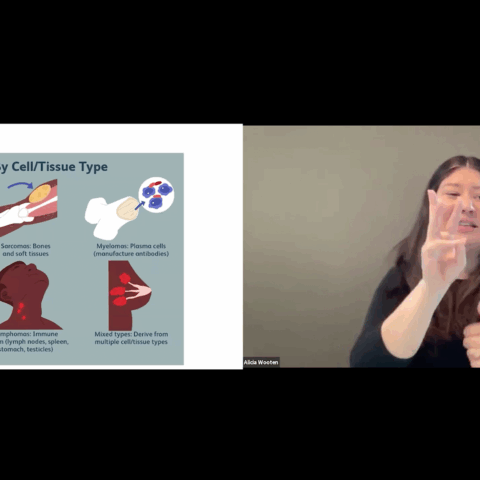
Biology in Motion: Signing Cancer Concepts
Price range: $37.49 through $49.99 -
Enroll in the course This product has multiple variants. The options may be chosen on the product page

Building and Sustaining Effective Designated Healthcare Interpreting Teams
Price range: $37.49 through $49.99