


No products in the cart.

No products in the cart.

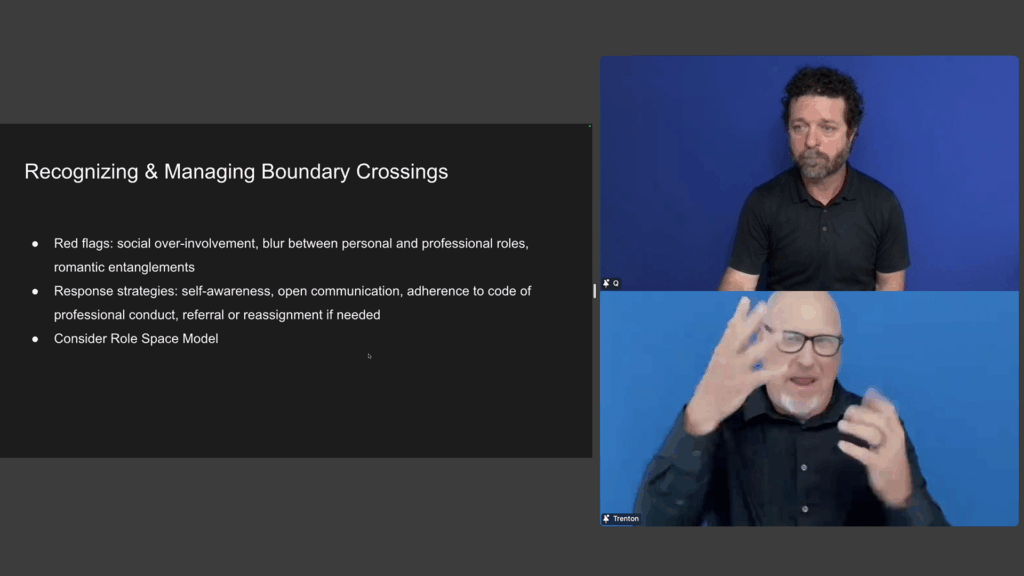
This is a presentation slide titled "Recognizing & Managing Boundary Crossings," which lists ethical red flags (social over-involvement, romantic entanglements) and response strategies for interpreters, concluding with the need to "Consider Role Space Model." The slide is shown alongside two video panels of men, one of whom is using American Sign Language.

Perspective on Interpreting for Deaf Professionals

Presented By: Jeremy Quiroga, MFA, CDI and Trenton Marsh, CDI

Course Duration: 2.0 hours


Subscription: 6 Months


CEU Credits: .2 PS

Perspective on Interpreting for Deaf Professionals

Price range: $37.49 through $49.99

Course Description & Objectives

Do you view the Deaf professional you work with as a consumer? Should that perspective shift? This workshop will explore shared experiences and mindsets of both Deaf professionals and the interpreters who work with them. We’ll examine how boundaries can become blurred over time, especially in long-term partnerships, and how to maintain healthy, professional relationships. Additional topics include effective teaming strategies—particularly when substitute interpreters are involved—the specialized skill sets and ethical considerations required in this unique context, and how to navigate situations where the Deaf professional is the subject-matter expert, especially when the interpreter may not fully grasp the technical content. Throughout the workshop, real-world stories and examples from the field will be shared and discussed.

Upon completion of this session, participants will be able to:

  • Identify and describe at least five distinct professional boundaries required when working with Deaf professionals.
  • Propose three actionable strategies for navigating team dynamics when a substitute interpreter is present.
  • List at least four specialized skill sets needed for a specific technical interpreting assignment.
  • List at least three examples of how confident and clear articulation can impact the perceived power and professionalism of an interpreter.
  • Propose at least three specific interpreting strategies that respectfully and effectively support a dynamic where the Deaf professional holds a position of authority.

Meet Your Instructors

Jeremy Quiroga headshot
Jeremy Quiroga, MFA, CDI

Jeremy Quiroga is an accomplished professional who channels his passion for life and American Sign Language (ASL) through national workshops and performances. Beginning his career as a medical interpreter, Jeremy became the first staff Certified Deaf Interpreter (CDI) for the University of Rochester Medical Center, marking a pivotal moment that steered his focus toward medical interpreting. With exceptional ASL mastery and a wealth of life experience, Jeremy delivers dynamic interpreter workshops equipped with a wide array of tools tailored for diverse interpreting settings. Currently, he works as a Video Remote Interpreter (VRI) specializing in the medical field. Outside of work, Jeremy enjoys cooking, hiking, and gardening, pursuits that reflect his zest for creativity and connection with nature.

Trenton Marsh headshot
Trenton Marsh, CDI

Trenton Marsh has been a communicator since he was knee high to a short chihuahua. Born to deaf parents and deaf siblings, he grew up attending the California School for the Deaf in both Berkeley and Fremont. After a year and a half at NTID majoring in Art, he went back West as a young man. His long and winding journey led him to Salt Lake City, Utah where he got his Deaf Interpreting certification and started interpreting and mentoring in the mid 2000s. Trenton has interpreted in a wide variety of settings and has specialized in medical interpreting over the past two years. He still lives in Salt Lake City with his wife Bonnie and two COCA-CODA kids, Madi and Rider.

Lighthouse Interpreting & Training is an Approved RID CMP Sponsor for Continuing Education Activities.

Enhance Your Expertise

Enroll in our courses today to elevate your engagement skills to the next level.

Additional information

Access Type

DO NOT RECEIVE CEUs, RECEIVE CEUs