
No products in the cart.

No products in the cart.

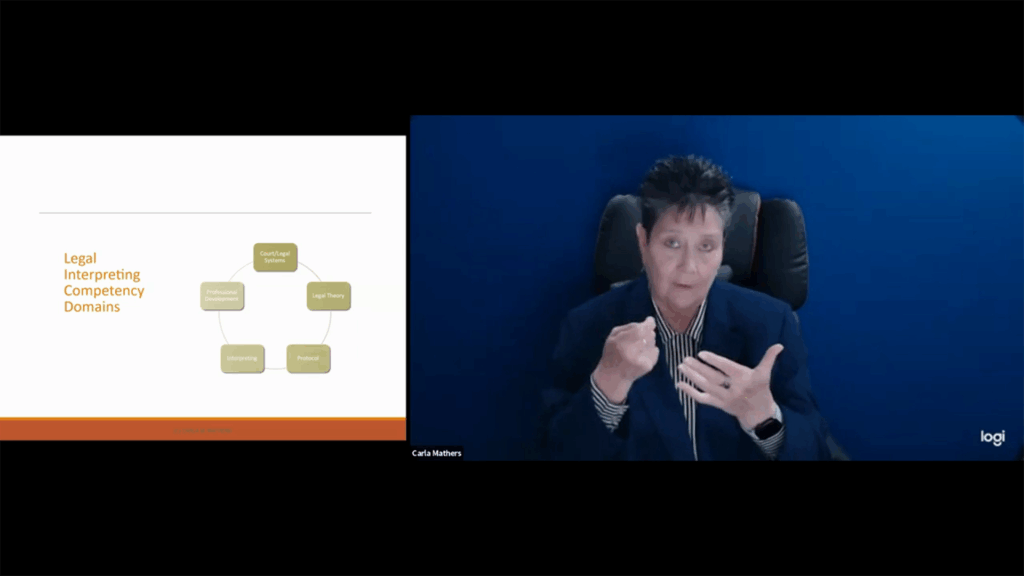
The slide shows a diagram of "Legal Interpreting Competency Domains" with a cycle connecting "Court/Legal System," "Legal Theory," "Protocol," "Interpreting," and "Professional Development." A woman with short dark hair and a navy suit jacket is signing, looking at the camera.

Court Interpreting Lite

Presented By: Carla M. Mathers, Esquire, SC:L

Course Duration: 4 hours


Subscription: 6 Months


CEU Credits: .4 Legal

Court Interpreting Lite

Price range: $74.99 through $99.99

Course Description & Objectives

This seminar will provide an overview of the legal system for practicing and potential court interpreters, including discussion of the roles of court interpreters, positioning of court interpreters, courtroom personnel, pre‑requisite knowledge and skills for a legal interpreter, court code of conduct, roles and protocol for court interpreters.

Upon completion of this session, participants will be able to:

  • Articulate the differences between community interpreting and legal interpreting, and the differences between legal interpreting and court interpreting.
  • State the three major functions used in court interpreting. State the three major functions used in court interpreting.
  • Explain how evidentiary principles such as hearsay and the contemporary objection rule affect interpreters.
  • Define the three accepted modes of interpreting in court and state the principles involved in note taking while consecutive interpreting.

Meet Your Instructor
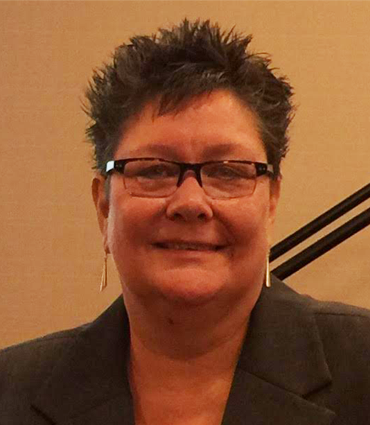
A headshot of a woman with short, dark, spiky hair and glasses. She is smiling faintly and wearing a dark suit jacket and long, slender earrings. The background is a plain, light brown wall with a dark diagonal line visible on the right side.
Carla M. Mathers, Esquire, SC:L

Carla Mathers practiced law in Maryland and the District of Columbia for over twenty-five years. She currently is an independent consultant teaching legal interpreters, and a practicing legal interpreter. Ms. Mathers’ law degree is from Howard University School of Law and her interpreting degree is from the College of Southern Idaho. She serves on the District of Columbia Courts Language Access Advisory Council and on the American Bar Association’s Advisory Group for Language Access Standards for the Courts. Ms. Mathers was a member of the RID Task Force on Legal Credentialing and of the Maryland Administrative Office of the Courts’ Advisory Committee on Interpreters, its Sub-committee on Ethics and its Sub-committee on Testing and Training. Ms. Mathers served as the Legal Program Coordinator for MARIE Center/DOIT Center at the University of Northern Colorado. She served as an adjunct instructor for the Gallaudet University Department of Interpretation teaching legal interpreting. She was Vice President for the Conference of Interpreter Trainers and was on the Board of Directors for the Deaf Abused Women’s Network in Washington, D.C. Ms. Mathers is the author of Sign Language Interpreters in Court: Understanding Best Practices, a text for interpreters, attorneys, and courts to understand the principles underlying ASL court interpreting.

Lighthouse Interpreting & Training is an Approved RID CMP Sponsor for Continuing Education Activities.
Enhance Your Expertise

Enroll in our courses today to elevate your engagement skills to the next level.
Additional information

Access Type

DO NOT RECEIVE CEUs, RECEIVE CEUs